Tuesday, June 28, 2011

Machu Picchu

    Two weekends ago was our much celebrated trip to Machu Picchu. The entire group had split into three- those hiking (5 day hike, around 300 dollars), those taking a van there (2 days, one night, small hike, around $145), and those who didn't go, or went with their families (no days, lots of money saved). I took the middle option, and we set off on a Friday morning early- extremely early for Kula and me (the only Urumbamba people who would be doing the van option) who had to wake up at 4 in the morning (I didn't sleep at all because I was too scared I would miss my alarm and then the trip), take a 1 hour combi to Cusco, and then a 30 minute taxi drive with a very lost taxi driver who drove in circles for the latter half of the trip muttering "I don't know this" to himself over and over in Spanish. 
     Once in the van our group slept for most of the drive, but woke up to observe the steep ascent across the face of many a mountain, on roads so narrow that you could no longer see the edge when you looked out the window, but rather the dried out bed of the moribund Urumbamba River, blocked by a dam. As entertaining as "car-on-the-edge-of-a-cliff" stories are, however, I have to admit that I never really felt unsafe or like our driver was recklessly flirting with our demise- I'm sure that there are a lot more terrifying roads out there, and less qualified drivers. 


     We debarked at the Hydroelectric station, and proceeded to walk 11 km along train tracks and through the jungle to our destination of the burgeoning resort town, Aguas Calientes. The walk was beautiful and reminded me of Costa Rica (the only other time I've been out of the country). While most of the group shopped, one other member, Detti, and I decided to go to the renown hotsprings, a 10 minute walk from our hotel. There, I was disappointed to find that the hotsprings were actually just water funneled into giant tubs- I had expected a more "authentic" atmosphere, maybe a waterfall and some rocks. I'm glad I went though, even if the notorious healing powers of the water did nothing to keep me from getting sick the next week (more on that later).


     On Saturday we again woke up at 4 in the morning to reach Machu Picchu in time to obtain tickets to climb Wayna Picchu, a gorgeous nub that sits right above the Machu Picchu ruins. Only 400 are allowed to climb it each day, which is why we arose so early. Climbing felt very nice in comparison to Chicon, where I thought I might pass out upon every ascending step. We scurried up Wayna Picchu fast enough to impress our tour guide (good progress, as the majority of us were in the "slow group" for Chicon) and spent the better part of an hour at the top, marveling at the view of Machu Picchu and surrounding mountains. 


     We also saw a 50-some couple from Brazil, thoroughly enjoying the healing powers of Machu Picchu (the landmark is said to be at the center of an energy vortex) as well as the effects of the hallucinogenic drug in which our tour guide informed us that they had copiously indulged. They sang and danced and played maracas (and were very well practiced, too)  to thank Mama Pacha (sp?), the Quechua phrase for Mother Earth. 
     

Monday, June 20, 2011

Sr. Torrechayoc

     Since our arrival in Urumbamba the locals have spared no energy informing us of how lucky we are to be volunteering during the time of the festival of Senor de Torrechayoc, the martyr whom after their church has been named. Two contrasting opinions solidified in the weeks before the festivities- those who adored the dancing, the ribaldry, the crowds that swarm in from neighboring cities, and those who despised the way in which a religious holiday had turned into an excuse to become incomprehensibly drunk for a span of 8 days, or were fearful for the safety of their homes from foreign rateros (thieves). My careful, teetotaling family made sure to always have a family member in the house to guard against the infamous rateros who made their way to Urumbamba every year to prey on the homes of unsuspecting drunks. 
     The inaugural Sunday arrived, and our host niece took my roommate and me to see a series of dances performed by locals sporting the most elaborate costumes that I had ever seen, the most ludicrous being the Diablada dance, in which very revealing fairies, fallen angels and devils danced alongside a variety of different sized gorillas. It was nice to see that the dancing was a family affair- next to the trained dancers small children (also adorably decked in extravagance identical to their parents) fluttered around, some trying to mimic their parent's complex footsteps, others plodding indecisively around the field. My favorite was a baby in a tiny gorilla costume perched atop his gorilla-father's shoulders for the entire ten minute dance, looking utterly confused the whole time.  
     
     The first few hours were quite interesting, but upon the third of sitting in the hot sun on concrete bleachers, each dance began to run into the next. And then the fourth and then the fifth. By the sixth we were huddled on cold concrete bleachers, no longer as enthralled by this display of Peruvian culture as we were in the morning.
     That night however, renewed our enthusiasm. We went to the office (conveniently next to the church), in front of which had been erected 3 multi-story spindly structures, apparently laced with fireworks. The first one was lit at 10 o'clock, Peruvian time (really 10:30) and we watched in awe as wooden spinners shot green and red sparks over our heads. Each structure put on around a seven minute show, complete with wooden wreathes that were shot -flaming- into the air, and then fell (still smoldering) into the audience. Before this spectacle, however, was one of a more dangerous events of the festival- an errant firework had landed on a woodpile next to our office and threatened to envelop it in flames. All of the volunteers, tipsy to the point of bravery, shot in through the gates and found empty buckets to hand to the frantic -and unlicensed- pyrotechnicians who had already scaled the wall and were shouting to each other in Quechua, the native language. Our director Kate frantically called the stoves boss, Jaime, who (under the impression that the office was being robbed, and calling upon his days as the night watchman) abandoned the festivities and ran into the courtyard with his fists bared, ready to hand-fight the dreaded rateros
     The next day was the parade, in which all of the dancers re-performed their Saturday dances throughout the streets of Torrechayoc. This was a bit more festive than the previous day, as each dance troupe displayed only their most perfected moves, rather than all ten minutes of the dance.  


     After the parade I got lunch with the Cusco group (a delicious American cheeseburger- perhaps an inappropriate meal amidst such a display of culture, but my cravings for American foods has reached somewhat obsessive), read in the office for a bit, then went home to dinner. The rest of Urumbamba, however, was just warming up for 6 more days of festivities. It wasn't until yesterday (the final and 8th day of the festival) that we heard our final percussion instruments and saw the last group of drunk individuals stagger arm in arm down the street.

Thursday, June 9, 2011

The New "Sad House"

     Each work weekday we travel to Janahuara or Ccotohuinchu, divide ourselves into groups of three or four, and each team hikes to their respective house to (hopefully) complete a stove. Each group hopes that their house will hold all of the necessary materials, smooth, pebble-less mud, and a cooperative family. More than anything, each groups will hope that they are not working at a "sad house". 
     In my first four weeks here, I have heard of only two houses being given that title- one in which there was no wall to support the chimney, the other in which a family refused to hold up their end of the deal (mainly by providing workable mud) and had to be left alone until they could take the project seriously. Then today three other volunteers and I unwittingly entered a home that would win the title of "sad house" from all the others.  
    There were two Duke volunteers and two new arrivals, who we were supposed to engage in on-the-spot training. Jaime, our boss, led us to a house where we were not immediately granted admission. We stood back as Jaime yelled through the thin wooden door in Quechua until we gained entrance. We walked in and were met by an old man leaning on a cane. One eye was white with blindness and the other I suspect had also failed, as it neither moved nor focused. He had a a small smile on his face as we delicately crept around him -at Jaime's request that we took extra special care not to bump into his frail figure. 

And then we were on our own. 
     Usually, the volunteers try to work alongside the stove recipient. My favorite stove was one in which the husband -who was perhaps younger than I- eagerly climbed onto the roof to cut the hole (usually one of our people has to do that) while we built the stove below. His wife found us whatever else we needed, and our breaks consisted of playing with their 6 month old baby in the yard. Yet this stove was vastly different. It wasn't that the recipient didn't help, it's that he couldn't. Our efforts to speak Spanish to him came to no avail, and I repeated the one phrase I knew in Quechua ("I am fine") over and over again throughout the morning so that he knew we weren't ignoring him. With difficulty we had to search out every material that usually is provided upon request and when we finally began we had to start not on the actual stove, but on building up the wall for the chimney with cumbersome and back breaking adobe bricks. This consisted of choosing a brick from the pile outside, and (with the help of a pick) separating it from its brothers. Then, haul it inside, hack away at it with the pick another time until it seems the right size, wet it, and finally hoist it up to another volunteer standing on the stove platform so they can use copious amounts of mud to stick it to the brick that lies underneath. The ground team and the platform team sweated equally, but the worst part came when we had to make more mud. As one of the new volunteers hacked away at the pile of dirt above the mud basin we heard a shout- "We've got ants!" 
    Thinking it was merely a few stray insects I ignored the call and continued to work on the wall, only to see out of the corner of my eye the older gentleman ambling across the room. I called to him to ask him what he was doing, and thus found out that he was quite deaf. The commotion outside continued so I followed the man out the door and found that the ants were a bigger problem after all- our mud basin was built at the edge of an anthill that came up to my chest. At this moment our attention was drawn again to the man, who had been making his way to an outhouse that we had failed to notice, hidden 20 feet away behind foliage. His cane was slipping on the underbrush, and he was struggling over the brick that we had unknowingly left in his way. The only male volunteer in our group helped support him there, a service that the man gladly accepted. Meanwhile, we decided to saturate the basin with enough water that the ants would leave the mud, or drown. That worked, but when Jaime returned to check on our progress he found three of us sitting forlorn and spattered in the dirt around the water spigot, trying to tie down the handle which wouldn't close. The other volunteer was helping the elderly man back from the outhouse. Confused, Jaime attempted to stifle the pouring faucet, speak to the old man, and put us back in order before he left again. While we wrestled with the water a pair of chickens had descended on our buckets and the old man had settled himself in a chair facing us, and proceeded to watch our progress on his stove. 
      Finally the proceedings became smoother, and although the work was still unusually difficult we settled into a rhythm. And I began to wonder about the old man. I wondered how he managed to live on this little farm, with no sight and limited mobility. I wondered if he was happy, when a trip to the bathroom took him the greater part of an hour. Later I found out that his wife was a good deal younger than him, and cared for her ailing husband. That made me wonder about the wife, and how her life differed from other women in that pueblo- was it consumed with caring for her husband, or was it less work or more joy than at seemed? What I was most curious about was why the old man was so content to watch us for a hour, although he could not understand us and probably could only barely make out our foreign forms. Yet he watched, with a hearty grin on his face: a look of pure joy. 
     Later, in Spanish class, I asked about the existence of elder homes in Peru. My teacher explained that they have them, but those that enter die quickly. Confused, I asked if this was a reflection of the quality- she responded that while the quality could be quite good, when a man like the one we had encountered has spent so long listening to the birds that chirp outside his home, or the river that runs through his land, or his wife chattering to him about whatever (whether he fully understands or not), moving him to a nursing home is a fatal mistake. Taken out of his habitat, he would die quickly. It was then that I realized why he sat their and smiled- even though he couldn't understand us, we were company. Even though he sat and watched us make a mess of his house, we were entertainment. He knew his life on the farm well, and slippery trek to the bathroom forgotten, he has comfortable and happy. 
     But the aspect of the day that I wondered about the most was how he was when he was younger. Now, we saw him as old, blind, decrepit. All we knew of him were his ailments. But he could only have been this way for a few years. I wondered how his younger self would feel if he could foresee this moment- a bunch of foreign students entering into the home that he had carefully constructed, in which he had perhaps used his big smile and wit to land his much younger wife and subsequently provided for her so that when he fell ill she would have the means to maintain the house. I wonder how the younger, more virile version of this jovial grandfather would feel knowing that we saw him and constructed our judgments of the situation based on this version of him. That we never knew him in his youth. He no doubt spent many years toiling in the rocks of Ccotohuincho, coaching a life out of the arid desert. Yet we have no idea about THAT man, only the old one in front of us, picking his way across the floor. Ninety percent of his life has most likely been filled with labor, self-sufficiency, and perhaps passion. Yet we will never know of that side. I wondered how different the way we saw him was from how he sees himself. I know that when I am old and my health is failing I will still think of myself as the 20 year old who built stoves in Peru, as the adolescent who likes adventure. But how will others see me? Most likely as we see the man- weak and vulnerable. He is a shadow of the man he used to be, yet we can never know that other man for comparison. I very much wish I could know what this old man was like  in his prime, and what would be his thoughts about his position today. 

Friday, June 3, 2011

Orthodontic Emergency: Peru style

     The apples in Peru are some of the sweetest I have ever tasted. Unfortunately, I enjoyed my last one today after an errant bite ripped out my permanent retainer, the one that's been attached to my bottom teeth for the past six years, protecting a $4,000 brace job from my teeth returning to their natural (and very crooked) state.
     I arrived at work and selected the juiciest  of fruits from the communal basket. I bit into the apple, and realized something was off. I felt the area with my tongue, and was immediately stabbed by the rogue wire. "Oh no," I thought, "I broke my retainer and need to get it fixed before my teeth start moving." Then I became cognizant of my whereabouts.
     "Oh no," I thought, beginning to panic "I broke my retainer and I am many miles and even more dollars away from my orthodontist, whom I will not be seeing for another 3 months." For many, this wouldn't be a problem- their teeth would handle the couple of months until their return. Unfortunately, I have a very small mouth and my wisdom teeth haven't been removed- without my retainer my superfluous will crowd the other ones until I've regained my childhood (an embarrassingly awry) bite.
     Distraught, I scurried into our program director's office and pointed over and over at my mouth, and tried to explain the situation. She understood my qualms about visiting one of the local orthodontists whose office's are nestled between hair salons, laundromats, and bakeries. She then remembered that another ProPeru worker is dating a dentist who works in Cusco (one of the bigger cities), who knows how to do permanent retainers.
Thank God.
     Within an hour I'm on a van to Cusco. I get there, and a very nice passenger who sat next to me and got to witness my distress (for an hour, poor man) hailed me a cab and even paid for it. Two hours after my apple, I was sitting in a dentist chair and my retainer was being reattached. The dentist laughed when I told him that a piece of fruit had been my downfall. "Una manzana MUY fuerte (It was a VERY strong apple)", I said, trying to defend my dignity.
     As it turned out it was good that I came in so soon- not only was my retainer broken all the way off (I thought it was only half but the other side had surreptitiousness begun to detach as well) but according to the dentist my teeth were already loosening. Hours after the whole ordeal it's still difficult/painful to eat as my teeth are still being pulled back into their desired position.
    I returned home to find that my host mother had misread my note and thought that I had been hit in the face by something and broke my teeth. I reread my note, and realized that I had made it sound as if I had, in fact, been hit by something and broken my teeth. Thankfully when she called the office the program director was able to explain it better and she wasn't worried anymore.
    What I learned today is that little emergencies happen fast and unexpectedly whether you're in a position to take care of them or not. I'm very grateful that this time I was in that position.

Tuesday, May 31, 2011

Summiting Chicon

    The Beginning
     From the moment we arrived in Peru it seemed as if we were training. Chicon, thousands of feet above Urumbamba, is known as being one of the more difficult hikes in the area. In the neighboring town, Chicon is the name of a glacier as well as the two mountains that support it. A massive, heaving monolith, we've heard stories of avalanches and of Chicon's gradual retreat up the mountain due to global warming. My host family hiked Chicon when their children were young, a 4 day affair. Ours was to take one and a half. 
"The Cross" Hike

     From the top of "The Cross" (a mountain with a cross struck into the very top, a sign of dominance of the Spainard's Catholicism over the native religion) Chicon is resplendent- flanked by clouds, the dark terrain gradually gives way to virgin ice and snow. "The Cross" hike takes about 30 minutes and is already tiring, but we complete it diligently day after day in order to grow strong for Chicon. 
The Twin Towers Hike


    Then came even more practice: the weekend before the hike we embarked up San Juan, the mountain of Los Dos Torres (the Twin Towers). This hike was to be about a third of the length of Chicon. After three and a half hours "the slow group" (of which I am a proud and permanent member) made it to the top. A day later my blisters and throbbing knees and quads foreshadowed the after effects of Chicon well. 


     Two days before Chicon most participants began to take altitude pills to deal with the vast height, although most succumbed to some sort of ailment sooner or later. The volunteers from Cusco arrived the night before and slept in the office. We gathered in the plaza in front of one of the town's two churches at 6 in the morning, tied our rented sleeping bags to our packs, and loaded ourselves, our packs, and our water into a small bus that would ferry us to the base of the mountain. A few people were using their school backpacks, but most had hard-core hiking backpacks specially fit by mountain-type people to their bodies, each one boasting more straps and danglies than the next. Mine was unique to the group: an external frame veteran of my Aunt's adventures, it came with no fancy gadgets but rather hand written tags on what I should put in each pockets as well as a poncho and a metal water bottle, which I've recently found keeps my water colder than anyone else's plastic one. 
     Upon reaching the base of the mountain we paid our one nuevo sol for the ride (equivalent to about 40 cents) and began to climb. Within five minutes members of the group (myself included) were out of breath. We then split into three groups, 4 boys went with the porters, who could do the 10 or so hour hike to the top in six, a few of us hung back to be in "the slow group", and the rest went into the middle group.
     After clamboring through brush for about an hour a forest opened up in front of us. It looked exactly like something from Lord of the Rings, with moss curling around every bent tree and a small, talkative river winding daintily around smooth piles of rocks, but I was so intent on putting one foot in front of the other whilst still breathing that I barely noticed. I made a mental note to take pictures when we passed through on the way down, and continued. 
"The Slow Group"


     This one-foot-in-front-of-the-other mentality continued from 7:30 in the morning to 3 in the afternoon. The slow group swelled and dwindled, and finally stabilized. We reached the campsite at least an hour after the fast group, who had already found our camping spot. After assembling our tent and eating the fried vegetables, rice and meat cooked by the porters, four of us fit ourselves into a tent (three tents, the rest slept in a small house constructed by ProPeru) and went to sleep. It was 7 PM, but the dark and the cold necessitated our cocooning ourselves in sleeping bags early. When I emerged from my tent at 5:40 to the porters shouting for us to wake up I expected to be spry,chipper and ready to do the last two hours of the climb to the glacier. Instead, I felt intense leg pain. Others were still suffering from altitude sickness, one had thrown up during the night, and other's had been unable to sleep due to cold, noise, or over-zealous cuddling on the part of their tent mates. I can't remember the last time I've taken so much medicine in a span of 24 hours- an altitude pill even 12 hours, Zicam for sniffles, Tums for altitude nausea, my regular inhaler, an emergency inhaler, and a combination of Advil and Motrin (Advil worked better). Usually, I avoid medicine, but for this hike I felt like a druggie, but I'm sure I wasn't the only one. Advil was being passed around like a Pez container and all of the Pepto in the first aid kit was gone by 7 the morning of the second day.
  The Final Two Hours


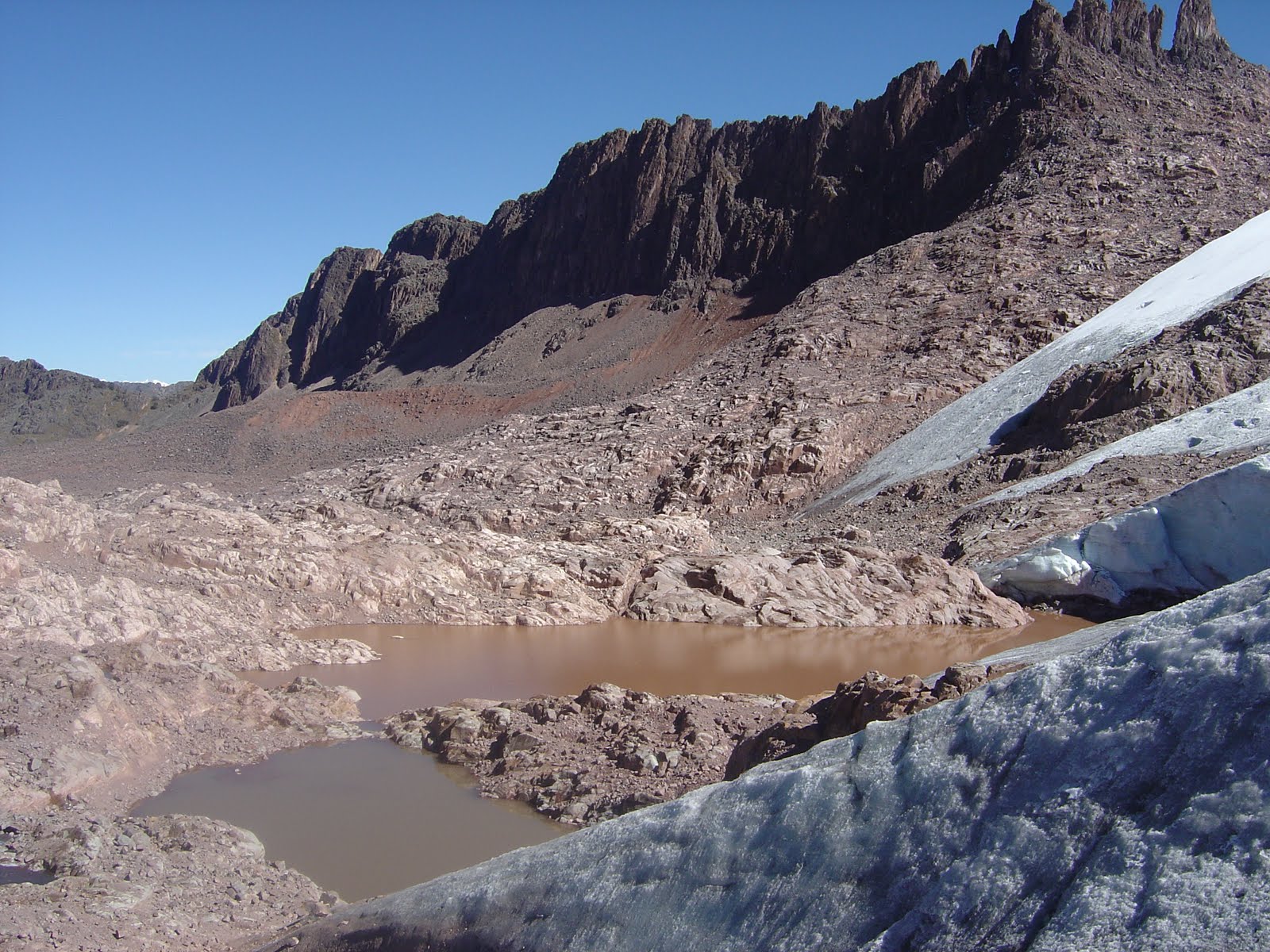
     The last two hours was a huge struggle, one that I barely remember. I kept my face down almost the entire time. Walk, walk, rest, rest. Walk, walk, rest, rest. First over grass and mud, then over huge hills of rocks. I felt like I was in Mordor (sorry for the continual Lord of the Rings reference). Nothing was alive, and every step had to be trod carefully lest the path you were on gave way and you tumbled to the bottom. Finally the glacier was in sight -a mound of snow jutting into the dim sky- and I experienced as odd flash of deja-vu- the glacier and its surroundings were oddly reminscent of Cleveland in the winter, when everything is shrouded by snow. I realized that I had hiked approximately 10 hours over two days to see what I saw  6 months every year of my childhood. I was vaguely disconcerted, and continued. 
At the Top


     We couldn't actually reach the top of the glacier, so instead we frolicked at it's base, climbing up rocks and then ice, and sliding back down again. I'll admit I expected a great deal more beauty from something so inaccessible (isn't that how it's supposed to go?) but I'm glad that I reached the top just to know that  I can. 
The Descent


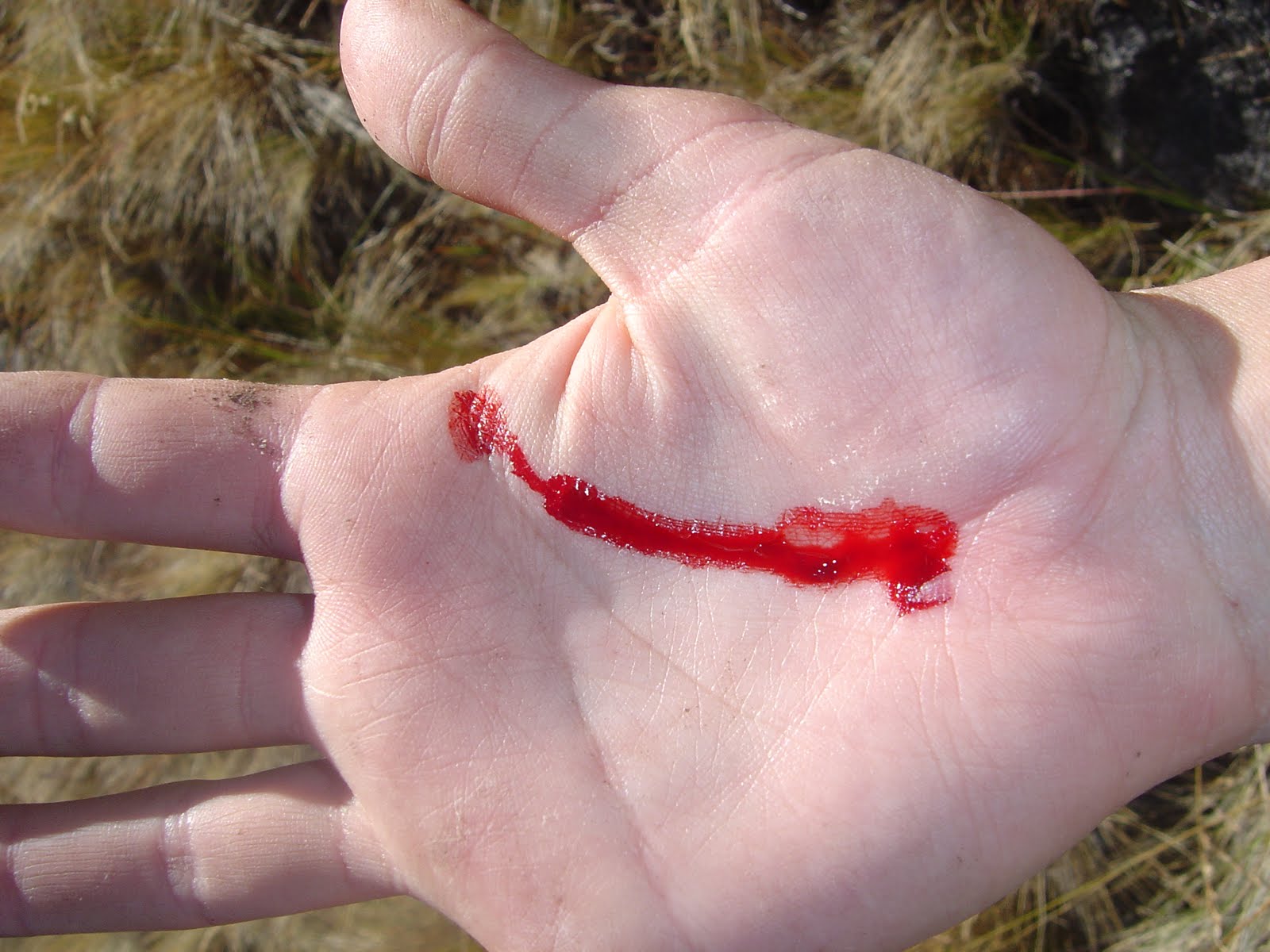
     The way down was probably my favorite... because it was less strenuous I could spend more time enjoying the surroundings . However, it was definitely more dangerous. One group member rolled and ankle and then the slope he was going down collapsed and he almost fell off the edge. Another volunteer almost slid into the river. I got a small cut on my hand, and experienced one of my more spectacular falls, sliding a couple feet on my butt and then on my knees when I tried to stand up and the weight of my backpack dragged me further. However, I did remember to take pictures of the forest on the way down, the most beautiful yet unsung part of the trek. 
     Ultimately, although I did expect quite a bit more from a gargantuan glacier in the Andes I'm glad that I did Chicon, for it was quite an adventure. 

Monday, May 30, 2011

The Routine

     After two weeks of work and almost three weeks of being in Urumbamba we have mostly discovered the pattern of gringos who live and work here temporarily. Wake early and have bread, butter and tea, trek through  the crowded streets until we reach ProPeru around 8:30. Usually we wait until about nine to learn our destination ("Peru time" is very relaxed) and walk back down to the bus station where we clambor into a combi (cross between a van and a bus, seats optional) or else dive 3 at a time, into a passing moto (a seat and an awning placed onto the back of a motorbike). 20 minutes later we arrive in towns that -despite their proximity to Urumbamba- are vastly different. Janahuara is rural and spread apart and while Ccotowinchu seems to be more organized there are few species of trees that have managed to create a stunted life in the arid, rocky terrain. 
     After hiking for a bit, our boss Jaime (hi-may) tells us which houses to build stoves in and we split ourselves into groups, usually two groups of three or four. We then enter into the gates of our respective houses fingers crossed: hoping that the mud is good, hoping the platform was built under the lowest part of the roof (less chimney to build), hoping for things we don't know that we are hoping for until they don't work out, and then we remember to hope for it in the future. First, we are greeted by the chickens and geese that reside within the gates, picking their ways around the hoe. Often times a baby or toddler will be playing quietly nearby, incorporating the livestock into their own little world. Then we enter into the the kitchen, or where ever the stove  will be. Once we placed  a stove in what I believe was someone's bedroom, as it had two neatly made beds. We flung the mud as carefully as possible, mindful of their blankets and decoration. 
      After being greeted usually by a woman and sometimes her husband (or conviviente, which is a spouse by law, although they are not legally married, something that seems to occur here as much as it does in the US) we are greeted by the cuy, which are guinea pigs raised to be eaten. Usually there are 10 to 15, and they run loose around our feet as we  build. Often timid enough to stay out of our way, the ones today were brazen and danced merrily around our shoes as we walked.  Also, it isn't uncommon for a chicken to use the opportunity of the open door to come in and watch our progress, perching on a rock or table and once even sitting on a bed. 
     Three and a half hours later we are hopefully done slinging mud, piling bricks, and stacking chimney tubes and we emerge from the home, find a means of transportation back to Urumbamba, and leave for the day. After walking home and shaking out my mudcaked clothes, I eat lunch with my family and then walk back across town for an hour and a half Spanish lesson. Then every other day we hike up a small mountain, use the Internet at the office, and come back for dinner. Dinner is a jovial affair, but at 8 or 9 my roommate and I are ready to sleep. Breakfast-work-lunch-class-mountain-dinner-bed... a simple routine that hasn't yet become boring as it is so rare. Also, because I have so little to do I get so much more done- I've e-mailed people I haven't talked to in years but wanted to, and been able to plan for this summer and next semester in ways I wouldn't be able to if I were still in the US. Life in Urumbamba is pastoral in someways, but I could never do what some people in our group have suggested, and live here. As much as I enjoy Peru, I'm incredibly excited for the Miami airport layover on the way back to the US, where I can buy a Wendy's frosty and a hamburger, and understand all of the signs. 

Friday, May 20, 2011

Saqsaywaman

     Before our group of 11 went off to Urumbamba we stayed in Cuzco (a larger city about an hour away from Urumbamba) with the 9 Cuzco volunteers and visited various ruins in the area, the most impressive being Saqsaywaman, which have been said to be anything from an Incan fortress to a temple, although the temple hypothesis has garnered the most evidence. From above, the ruins are zigzagged, a tribute to lightening. 


Before we got to the ruins we happened upon a grizzled farmer and his pack of llamas, which he allowed us to photograph as he stood off to the side. We hiked through the ruins, many of us gasping for air at the smallest incline as we have yet to acclimate to the altitude. It wasn't until we reached the foot of the giant walls that we realized the magnitude of what the Incas had done... huge boulders that towered over the tallest in our group, each perfectly aligned with the next, each stone's protrusion snuggly set into another's  indentation. 

    The day before the ruins we visited the enormous, alabaster Jesus that watches over Cuzco, his arms stretched wide as if embracing the city. At his feet vendors sold alpaca hats, dark stone miniatures of the statue, and Incan crosses. There was also a woman with a llama (possibly an alpaca, I have yet to gain enough experience with the two to tell the difference) who encouraged our group to take pictures with her. This has happened countless times in our week here- Peruvian women in traditional garb canvassing the plaza for gringos who want a culturally “authentic” picture, older women sitting perceptively next to ruins, spinning alpaca fur into yarn. What seemed at first to be a kind gesture towards foreigners revealed itself to be a practice in entrepreneurship- after a picture is taken the women will ask for money for their efforts. 
     However breathtaking any of the ruins or monuments, the view of the mountains as well as Cuzco nestled in the valley is indisputably the most beautiful part of the trip thus far.